Pubs in Preston: where the drinking trade actually sits in the city
Geography, because a named pub list is the fastest-perishing thing a city guide can publish.
Preston's pub trade is concentrated in a few streets, and knowing where those are is more useful than any list of names. Pub names, ownership and trading status change faster than almost anything else on a high street, so what follows is the geography.
A named pub list from a previous year sends people to premises that have closed, changed name or changed character entirely. That is the single most common failure in printed and online city guides, and it is avoidable by describing streets instead.
Friargate and the north
Friargate running north from the Ringway carries the densest concentration of the city centre drinking trade, and it is the street most affected by the student population at UCLan immediately beyond it. It is busy in the evening and quiet in the day.
The Fishergate end and Winckley Street
The western end of Fishergate and the streets around it carry a different trade, after-work and rarely late-night, serving the professional quarter around Winckley Square. Winckley Street itself has become food-and-drink led.
The market quarter and Church Street
East of the Flag Market, around Church Street and the markets, the trade is older and more mixed. This is where the traditional houses concentrate, and it is the part of the centre most changed by the market quarter regeneration.
The village pubs
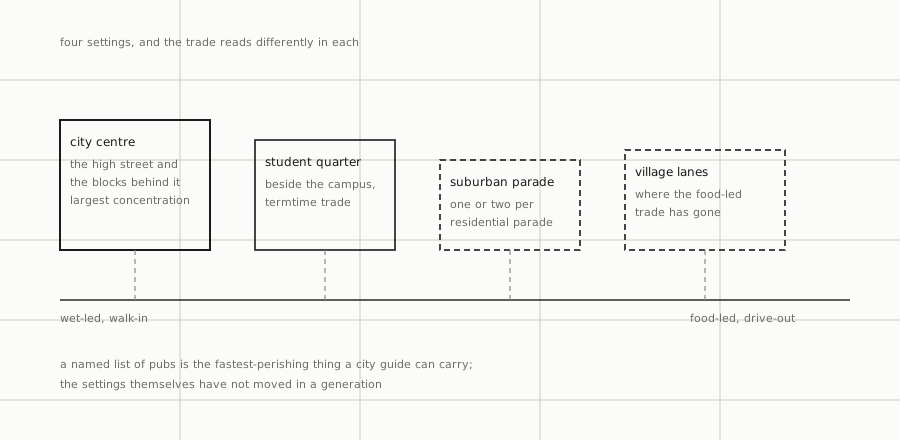
Outside the city the pub trade is village-based and reaches into the Ribble valley, towards Longridge, Ribchester and Chipping, and south towards the Chorley side. Those are driving destinations and they are where the food-led trade has gone.
Why no names
Because a pub list is a liability. Between the closures of the last two decades, the changes of ownership and the conversions to other uses, the failure rate of a named list is high enough that publishing one does more harm than good.
What is stable is the street pattern and the character of each concentration. That is what this sheet records, and it is the part that will still be true in five years.
Two trades, not one
Preston's pub provision splits geographically and the two halves behave differently. The city-centre trade serves shopping footfall by day and an evening trade that is thinner than the city's size suggests, and it sits in the streets around Fishergate and the market quarter. The village pubs beyond the built edge serve their own settlements, are reached by car or on foot from a walk, and keep hours and character set by that.
The physical stock reflects the split. Central Preston has Victorian and earlier buildings in a tight street pattern, several of them listed, which is why the centre's pubs are interesting as architecture as well as anything else. Outside the city the buildings are older and lower, often on lanes that were the main roads before the turnpikes and the motorway moved the traffic.
Where the villages are
The ring of settlements around Preston is genuinely varied. North along the A6 through Broughton and Barton the land is farmed and flat; east across the Ribble it climbs towards Longridge and the Bowland fringe; south towards Leyland and Chorley it rises to the West Pennine edge; west it flattens into the Fylde plain. A pub walk in any of those four directions is a different landscape.
Entries here record what a place is and where it sits.
Questions about Pubs in Preston
Where are the pubs in Preston city centre?
Three concentrations: Friargate to the north, the western end of Fishergate and Winckley Street for the after-work trade, and Church Street and the market quarter for the older houses.
Which street has the most pubs in Preston?
Friargate, running north from the Ringway, carries the densest concentration and is the street most affected by the university population beyond it.
Are there good village pubs near Preston?
The trade outside the city is village-based, reaching into the Ribble valley towards Longridge, Ribchester and Chipping, and south towards Chorley. Those are driving destinations.