Food to go in Preston: the midday trade and where it sits
The one food category in the city whose geography is settled by footfall per hour, and nothing else.
Food to go is the only part of Preston's eating that is sited on one number: how many people walk past the door between noon and two. Everything else in this section answers a catchment, a rent or a car park. A takeaway counter answers a pavement.
That makes its geography the most predictable of any category here, and the easiest to search badly. The trade collects where people already are at midday, and it thins out to nothing a few hundred metres beyond that, whatever the population density says.
Food-to-go businesses in Preston sit where the midday pedestrian flow is: the shopping streets, the market site and the office blocks, and almost nowhere else.
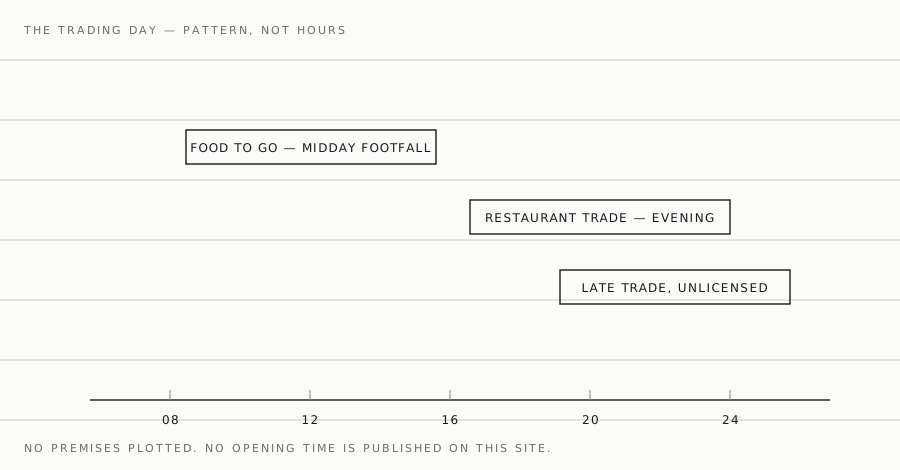
The three places the midday flow actually is
The commercial core is the first: the run of Fishergate and the streets off it, where the shopping footfall and the office lunch hour arrive together. The markets are the second, and the market hall's own counters are part of this category whether or not a search calls them that.
The third is the university quarter immediately north of the centre. UCLan puts a large population within walking distance of a narrow band of streets for most of the year, and the food trade in those streets is shaped by it: cheaper, faster and more crowded at one o'clock than anything in the commercial core.
Why the format does not follow the population
A residential district generates evening demand and almost no midday demand, because the people who live there are somewhere else at lunchtime.
This is the reverse of what happens to the cuisine categories on this site, where the trade moves outwards to find cheap frontage. Here the rent is worth paying, because the rent is the footfall.
What a search for this category will and will not find
A search made at midday from inside the centre works well: what is nearby is what is open, and the walking distances are short enough that the list is real. A search made from a car, or from a district, returns the same centre-weighted list and it will not be useful, because the format does not exist in the numbers a search implies once you leave the pavement it depends on.
The evening equivalent of this question is a different category entirely. The restaurant trade is on the eat and drink index, and the late-night end of it is the dessert trade, which starts when this one has closed.
The category that moves first when footfall moves
Because the whole business is pedestrian flow, this is the most sensitive part of the food trade to any change in it. When a large retail unit closes, the counters within sight of its doors feel it within weeks, and they move or close long before a restaurant two streets away notices anything. That is the same mechanism working in reverse: the format arrived on those pavements because the flow was there, and it leaves when the flow does.
So the geography of this category is younger than the buildings it occupies, and it is worth treating a list of it as a snapshot rather than a map. What holds is where the flow is: the shopping run, the market, and the campus. What changes is which unit on those streets is currently trading.
Two lunch hours that behave differently
The midday trade divides into two crowds that a single map flattens. Office lunch is narrow and punctual, concentrated in half an hour, loyal to whatever is closest, and it collapses entirely in August and over Christmas. Shopping lunch is wider, later, less predictable and heaviest on a Saturday, which is the day the office crowd does not exist at all.
A unit that serves both is standing where the two catchments overlap, and there are not many such addresses in Preston: the top of Fishergate, the market site, and the block between them. Everywhere else, the format is serving one crowd and closing when it goes.
Questions about Food to go in Preston
Where is the best area in Preston for food to go?
The commercial centre around Fishergate, the market hall counters, and the streets immediately south of the university campus. Those three carry almost all of it, because all three have a large number of people on foot in the middle of the day.
Why are there so few takeaway counters in Preston's residential districts?
Because the format lives on midday pedestrian flow, and a residential street has almost none — the people who live there are at work elsewhere.