Restaurants in Preston: the city centre band and the residential trade
The index's category for the non-British restaurant trade, described by band rather than by street.
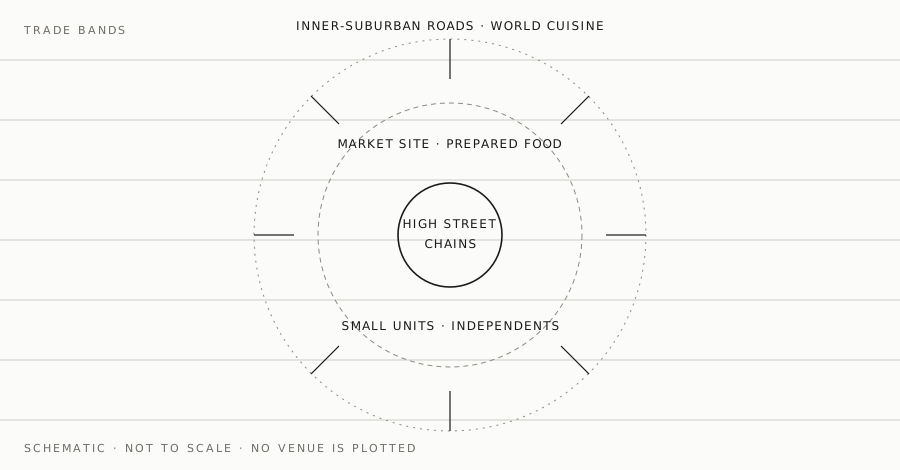
Preston's restaurant trade sits in four bands and only one of them is in the middle. The high street and the two covered centres carry the national and regional operators. The small streets running south of it carry the independents. The market site carries prepared food. And the world cuisine trade — the largest of the four by number of businesses — is spread through the residential and inner-suburban streets, which is a consequence of where the city's communities live, and owes nothing to a planning decision.
That last point is the one that catches visitors out. Somebody searching for restaurants in Preston city centre and finding the chain band concludes the city is thin on choice. It is not thin; the choice is simply four minutes' drive out, along roads nobody walks down by accident.
What the centre actually holds
The mid-market band in the centre is the part a visitor meets first, because it fronts the street a visitor arrives on. Bistrot Pierre is the French entry in it and Turtle Bay the Caribbean one, both central, both part of that band, and not of the independent trade.
The centre is small enough to walk end to end in about fifteen minutes, so once you are in it the whole band is available on foot. That compactness is a real advantage and it is the reason a central evening works without a car.
Why the rest is out along the roads
Preston's expansion followed the arterial routes and never spread evenly, so the suburbs are ribbons of housing along roads with green land left between them. A trade that serves a residential population therefore ends up strung along those ribbons, and a city of this size never accumulates enough of any one cuisine in one place to form a quarter.
The practical move is to pick a direction; the street matters far less. The corridors running north east and east carry most of it; the Thai and Chinese sheets describe two strands of the same geography from their own side.
Why the trade is described by band
It describes the trade by band and names no individual restaurant. Restaurants open, close, change hands and change format on a timescale of months, and a reference page carries no date stamp a reader will notice, so a named list from a previous year misdirects more people than it helps.
The directory records venues by name and location without claiming anything about their trading, which is the most this site will do. For anything about tonight, the venue is the source.
Two cuisines are kept on their own sheets rather than inside this band, because their geography differs from it: Italian, which in Preston is largely an out-of-centre restaurant trade, and Chinese, which is the most widely spread of any of them.
- French / 01
Bistrot Pierre
French bistro provision in the city centre.
- Caribbean / 02
Turtle Bay
Caribbean restaurant and bar in the centre.
- Cuisine / 03
Thai food in Preston
Where the restaurant and takeaway trade sits.
- Cuisine / 04
Chinese food in Preston
A spread trade with no designated street.
A category that is really a residue
World cuisine is not a cuisine, and the label conceals what the grouping actually is: everything the local trade did not already have a name for. It puts a Caribbean restaurant, a Turkish grill and a Thai kitchen in one box on the strength of what they are not, which is why the geography of the box is the only thing about it that holds together — and the geography is real, because the same rent and unit logic pushed all of them out of the centre.
Read as a residue it becomes useful. It tells you where the city's newer food businesses could afford to open, which is the inner-suburban roads, and it dates the arrival of each strand by the housing it sits in front of.
Questions about Restaurants in Preston
Where are the best restaurants in Preston city centre?
A ranking dates faster than the page carrying it, so what this sheet offers instead is the geography: the city centre band is the mid-market and chain provision, and the independent trade sits on the small streets immediately south of the high street. Which of those is best depends on the evening you want.
Are there many restaurants in Preston?
More than the centre suggests. The largest part of the trade by number of businesses sits out along the inner-suburban roads, well away from the middle, so a search confined to the city centre sees a fraction of it.
Does Preston have a restaurant quarter?
No. There is no designated quarter and no single street. The trade follows the residential geography, which in Preston means ribbons of housing along the arterial roads.
What is the world cuisine category?
It groups the non-British restaurant trade — the Indian, Chinese, Italian, Thai, Mediterranean and tapas sheets each have their own — and describes where that trade sits: spread through the residential and inner-suburban streets rather than in the centre. It is a category of the index, and no description of a place.