Deepdale Stadium: Preston North End's football ground and Invincibles
A football ground that has been in continuous use since 1878, on a site with a stronger claim on the origins of league football than almost anywhere else.
The Deepdale Stadium Preston North End tenancy has run unbroken since 1878, on a ground about a mile north east of the city centre. That date is the point of the place: it makes the Deepdale football ground among the oldest continuously used football grounds in the world, and it means the ground was already established when the Football League was founded.
The Preston North End shop sits at the ground, which is the practical reason most non-matchday visitors come up to Deepdale at all.
It is on this sheet as a heritage site, and not only as a sports venue, because the Deepdale stadium Preston North End story is inseparable from the early history of organised football in England.
Preston North End at Deepdale Stadium, without a break since 1878
Preston North End were a founder member of the Football League in 1888, and they have played at Deepdale throughout. The Deepdale stadium Preston North End association is therefore unbroken in a way very few clubs can match — the ground has been rebuilt around the club in stages, but never relocated.
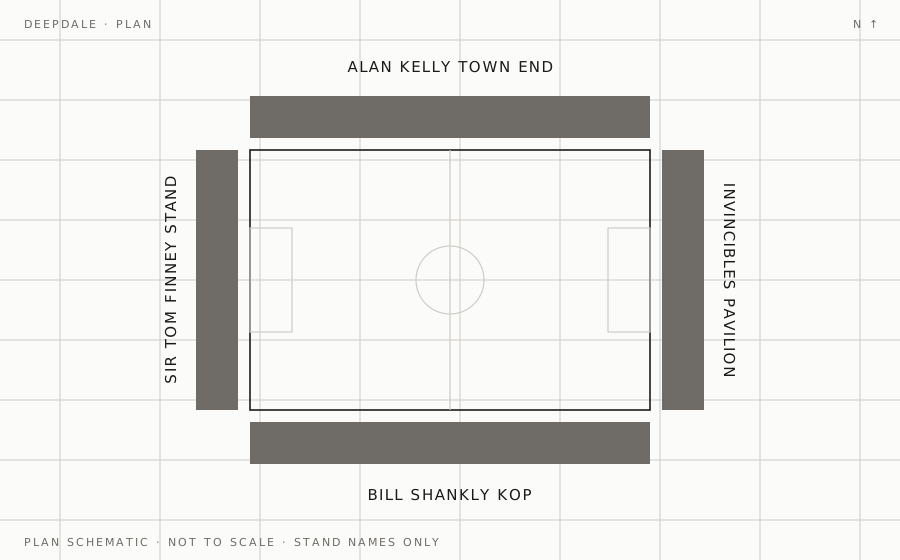
The Preston North End Deepdale ground has been rebuilt in stages around that tenancy, and the four stands are named, never numbered, and the names are the quickest history lesson available: the Sir Tom Finney Stand, the Bill Shankly Kop, the Alan Kelly Town End and the Invincibles Pavilion. Finney played his entire senior career for the club. Shankly played for Preston before he became a manager elsewhere. Kelly was a long serving goalkeeper. The Invincibles are the 1888-89 side.
The Invincibles of 1888-89
Preston North End won the inaugural Football League in 1888-89 without losing a match, and took the FA Cup in the same season without conceding a goal. That double is the reason the side is called the Invincibles and the reason a stand at Deepdale carries the name.
The Preston North End Deepdale record from that season is the reason the ground has a claim on football's origins that is disproportionate to the club's modern league position: the first champions of the first league played here, and the ground they played on is still the ground in use.
Among the oldest football grounds still in use
Continuous use since 1878 is the specific claim, and it is worth being precise about what it means for the Deepdale football ground. The Deepdale football ground has been redeveloped repeatedly — every one of the four stands is a modern structure — so nothing standing today is Victorian. What is continuous is the site and the tenancy; the fabric is not.
That distinction matters if you come expecting a period ground. Deepdale reads as a compact modern stadium on an old site, and the history is carried in the naming and in the club's own displays, not in the architecture.
When the National Football Museum was at Deepdale
For over a decade Deepdale housed the National Football Museum, which drew visitors to Preston specifically to see it. The museum moved to Manchester in 2012, and its departure is the single biggest change to the visitor case for the ground: the football heritage remains, the national collection does not.
Anyone planning a visit around football history should know that before travelling. The rest of the city's heritage sites are indexed on heritage and sights, and the walk in from the centre passes Moor Park, which is worth building into the same trip.
Walking out to Deepdale from the city centre
Deepdale is a walk, not a journey. From the Flag Market the route runs north through the university quarter and across Moor Park, then out along Deepdale Road, and takes a little over twenty minutes at an ordinary pace. That crossing of Moor Park is what makes the trip worth doing on foot: the park is the oldest in the city and the ground it occupies was Preston's common moor.
The alternative is the local bus network from the city centre, covered on the travel sheet. On matchdays the streets immediately around the ground behave the way they do around any English football ground, which is worth knowing if you are arriving by car; parking covers the city centre options.
Tom Finney, and why the stand carries his name
Of the four stand names, Sir Tom Finney's is the one that needs least explanation locally and most explanation elsewhere. Finney played his entire senior career for Preston North End, never moving to a larger club in an era when a player had little say in the matter, and he worked as a plumber alongside it. He is the reason the club's identity is bound up with loyalty, and with no trophy.
That is the frame in which the rest of the ground reads. The Invincibles are the achievement, Shankly is the name that left and became famous elsewhere, and Finney is the one who stayed. A visitor who knows only that much has most of what the stand names are saying.
The statue outside the ground makes the same point in bronze. It reproduces a 1956 press photograph taken at Chelsea, in which Finney rides through a flooded pitch with the water thrown up around him — the image has been known ever since as The Splash — and the sculpture is built as a water feature, so the spray is part of the thing rather than a description of it. It stands beside the stand that carries his name, and it is the one part of Deepdale anyone can see without a ticket.
Questions about Deepdale Stadium
How old is Deepdale Stadium?
Preston North End have played at Deepdale since 1878, which puts it among the oldest continuously used football grounds in the world. The stands themselves are all modern — what is continuous is the site and the club's tenancy, never the structures.
What are the four stands at Deepdale called?
The Sir Tom Finney Stand, the Bill Shankly Kop, the Alan Kelly Town End and the Invincibles Pavilion. Finney played his entire senior career for the club, Shankly played for Preston before managing elsewhere, Kelly was a long serving goalkeeper, and the Invincibles are the 1888-89 side.
Who were the Preston North End Invincibles?
The 1888-89 Preston North End side, which won the inaugural Football League without losing a match and the FA Cup in the same season without conceding a goal. A stand at Deepdale is named after them.
Is the National Football Museum still at Deepdale?
No. The National Football Museum was housed at Deepdale for over a decade but moved to Manchester in 2012. The club's own football heritage is still at the ground; the national collection is not.
Where is Deepdale in relation to Preston city centre?
About a mile north east of the centre. The walk out passes Moor Park, which makes a reasonable combined trip.