Boilton Wood: ancient woodland on the north bank of the Ribble
The oldest woodland in the city's reach, and the reserve that most rewards slowing down for.
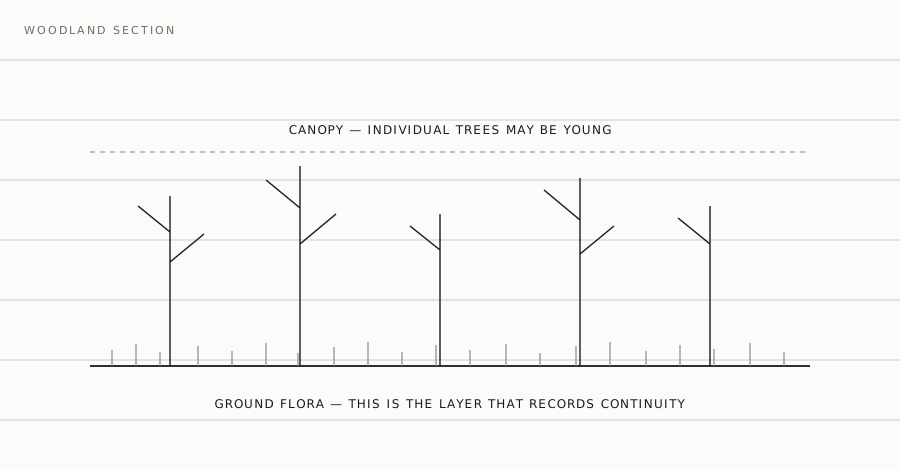
Boilton Wood is a woodland reserve on the north bank of the River Ribble at the eastern edge of Preston, beyond Fishwick and towards the Brockholes side of the valley. It is ancient woodland, which in practice means continuity of tree cover. The individual trees may be young; the ground flora is the thing that marks it out.
It is reached from the river path, and therefore from the eastern section of the Guild Wheel. Of Preston's reserves it is the one where the difference between habitat management and park management is most obvious, because the wood is left to behave like a wood.
Paths are informal and the ground is uneven. There are no facilities and no waymarking to speak of. It is best combined with the river walk east from Fishwick, and rarely approached on its own.
Why the reserves are where they are
What distinguishes this one is that continuity does not photograph: an ancient wood and a regenerated one look much alike in a picture, so this is the site that repays walking slowly and reading the ground rather than the canopy.
Boilton is the ancient-woodland end of that band, which makes it the least made of the sites: woodland that has held continuously, not regenerated onto cleared ground. The practical difference is in the ground flora — continuity shows in what grows under a wood, not in how old the individual trees look.
Ground conditions, and what to combine it with
None of these is a surfaced site. Under a closed canopy the ground stays damp long after the weather has cleared, which is ordinary for ancient woodland and is the reason the ground flora is what it is; it also means the going underfoot bears no relation to how dry the day looks from the road. The nature reserves sheet covers the conditions across the group, and the municipal parks are the alternative if made paths are what you want.
The natural pairing is with Brockholes, which is close by and the exact opposite kind of place: a made wetland on former gravel workings. Ancient woodland next to engineered lake in one walk is the best short lesson in what the Ribble corridor is.
Reading an ancient wood
Continuity does not show in the size of the trees, which is the common misconception. An ancient wood may have been cut and regrown many times; what makes it ancient is that the ground beneath it has been wooded without interruption, and the evidence for that is in the flora and the soil, not in the canopy.
That is why a site like this repays a slow walk more than a long one, and why spring is the season that shows it: the plants that indicate continuity are the ones that flower before the canopy closes. Later in the year the same wood tells a visitor far less.
Questions about Boilton Wood
What kind of woodland is Boilton Wood?
Ancient woodland, meaning continuity of tree cover over a long period. The ground flora is what marks that out, and the age of the individual trees says little.
How do you get to Boilton Wood?
From the River Ribble path at the eastern edge of Preston, beyond Fishwick. The eastern section of the Guild Wheel follows the same line.
Is Boilton Wood managed as a park?
No. It is managed as habitat, which is why the paths are informal, the ground is uneven and deadwood is left standing.