Tapas in Preston: the small-plates format and where it can sit
A format that is picky about buildings, which is why there are few of them and why they are all in the middle.
Tapas is a centre format in Preston, and the building is the reason. Small plates work on turnover: a table that seats four for ninety minutes twice in an evening earns more than the same table let once, and a counter earns more again because nobody is waiting for a table to clear. That wants a wide, shallow unit with the door on a busy pavement, and Preston has those in exactly one place.
It also explains the number. There are very few units of that shape in the city, so the category is small and it is not going to grow by moving outwards, which is the direction the rest of the trade takes when the centre gets expensive.
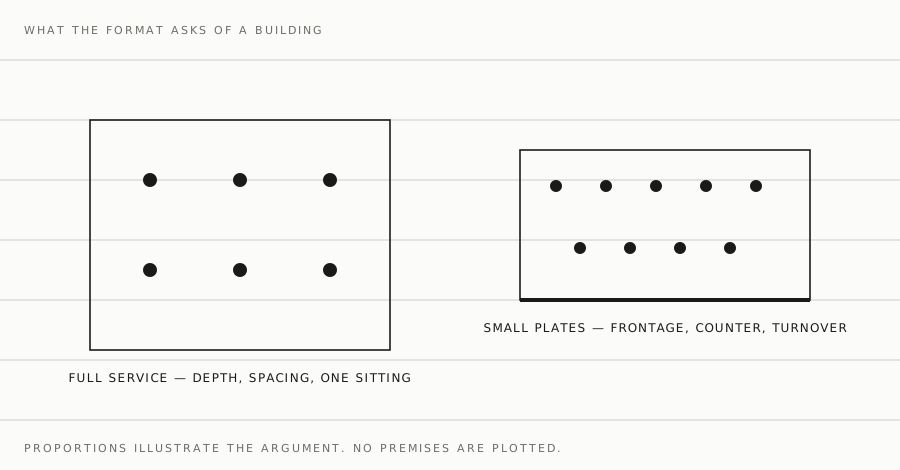
Frontage over depth, and why that is unusual
Most restaurant formats want depth: a deep unit hides the kitchen at the back and fills the front with the best tables. Small plates want the opposite, because the counter is the product and the counter has to be seen from the street. A deep Victorian shop unit with a narrow front is close to unusable for it, and that is most of what Preston's older streets contain.
The units that do work are on the wider frontages of the commercial core, which is also where the rent is highest. The format can pay it, because the turnover is the whole point.
An evening trade with no lunch
Small plates sell in the evening and barely at all at midday, which puts this category on the opposite side of the day from food to go even though both live on the same pavements. A visitor planning around it should treat it as a plan for after six, and should not expect the same streets to offer it at one o'clock.
It sits alongside the Mediterranean trade in the same part of the city, and the two are often searched as if they were one thing. They are not: one is a way of serving, the other is a region.
How to search this category
Search for the format, not for the country. A search for Spanish food in Preston returns a short and slightly misleading list, because what the city actually has is small-plates service, some of it Spanish and some of it not. Searching for tapas returns the format, which is what a group of four deciding where to spend an evening is really asking about.
The wider evening restaurant picture, including the chain band that sits in the same streets, is on the eat and drink index.
Why the format suits an uneven group
Small plates solve a problem a menu of courses cannot: a group of six who want to spend different amounts and eat different quantities can all order from the same table without anyone's choice being visible as a compromise. The bill divides evenly because the order was shared, which removes the awkwardness that ends most arguments about where to eat.
That is a social property rather than a culinary one, and it is the reason the format spread across British city centres in the first place. In a city the size of Preston it also explains the small number of them: the format is chosen for a specific kind of evening, not for eating out in general, so the demand supports very few rooms.
Floor economics, and why the centre is the only place
Small plates need turnover the way a chip shop needs an evening: the average spend per head is lower than a main-course restaurant's, so the room has to fill more than once, or fill for longer, to reach the same takings. That is only possible where people are already out — an evening centre with theatre, cinema and pubs inside a walk — which is why the format does not appear on the residential parades that carry most of the city's other food trade.
It also explains the pairing that visitors notice. Tapas rooms sit close to the places that create the evening rather than close to where the diners live, and the two or three addresses that work are the ones inside that ring.
Questions about Tapas in Preston
Is there much tapas in Preston?
Not much, and the reason is architectural. Small plates need a wide shallow unit with the counter visible from the street, and Preston's older streets are mostly deep units with narrow frontages. The few that work are in the commercial centre.
Where is the tapas trade in Preston?
In the commercial core, on the wider frontages. It does not move outwards the way the rest of the restaurant trade does, because the format depends on turnover and turnover depends on passing trade.
Is tapas in Preston a lunchtime option?
Rarely. Small plates are an evening trade here; the same streets at midday are food to go and market counters. Plan it for after six.