Traditional food in Preston: the neighbourhood trade, parade by parade
The category that is everywhere and nowhere in particular, because it follows the population instead of the footfall.
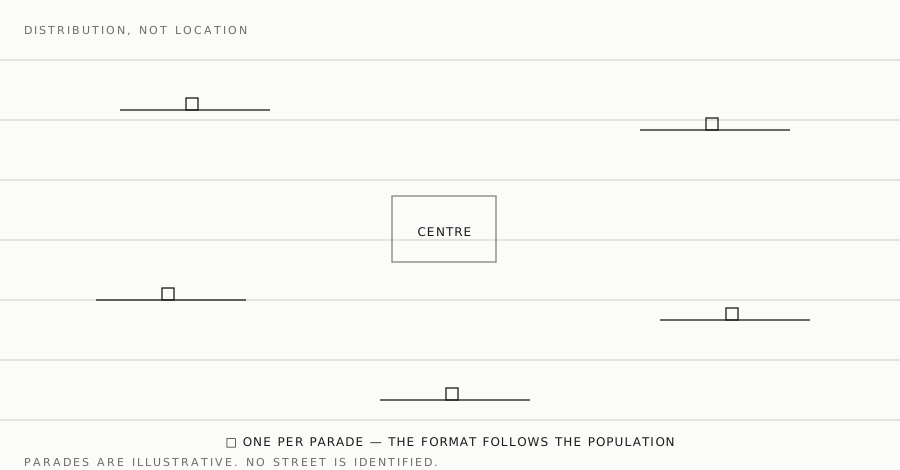
Traditional food in Preston means the chip shop, the cafe and the grill, and its distribution is the plainest fact about it: roughly one of each to a shopping parade, spread across every district of the city, with no concentration anywhere. It is the oldest continuously trading food category in the place and the only one you can reach on foot from almost any street.
That distribution is what a search for it usually gets wrong. There is no quarter to walk to and no street that holds several, because the format was built around the population living within a few minutes of the door.
Why one to a parade, and never two
A neighbourhood food business draws on the households inside a short walk, and that number is fixed. Two of the same format on one parade halve it for both, so the trade settled into a pattern of single occupancy that has held for decades. Where a parade does carry two, they are usually different formats sharing an evening: a chip shop and a grill, not two chip shops.
The consequence for a visitor is that the nearest one is nearly always the only one worth considering, and that the useful question is which parade you are near, not which name to look for.
The city centre is the gap
The commercial core is the one part of Preston where this category is thin, and the reason is rent. A format built on low prices and local custom cannot carry a central retail rent, so the centre's cheap eating is food to go and market counters, which turn over faster at a higher price per square metre.
So the map inverts what a visitor expects. Walk out of the centre in any direction and the traditional trade appears within ten minutes; stand in the middle of it and there is very little.
What has changed, and what has not
The names on the parades turn over; what holds is the pattern. The number of these businesses across Preston has stayed remarkably steady while the city's restaurant trade has churned, because a cheap local format survives the conditions that close an expensive one.
The rest of the city's eating divides by cuisine and by evening trade, and that is on the eat and drink index. This category divides by district, which is why it has no index of its own beyond the geography above.
A weekly rhythm, not a daily one
Unlike every other category on this site, this one trades on a week rather than on a day. The chip shop's business is concentrated into a few evenings, Friday hardest, and the rest of the week is quieter than the shopfront suggests. A cafe on the same parade is the mirror image: weekday mornings carry it and the weekend is thinner.
That matters for anyone planning around it, because a parade that looks busy on a Friday evening can be almost closed on a Tuesday, and the reverse is true of the morning trade. It is also why the two formats sit side by side so comfortably: they want different parts of the same week from the same households.
The last independent unit on the parade
On most Preston parades the chip shop is the final non-chain food business standing, and that is a fact about rent rather than about appetite. The format survives on a footprint no multiple wants, with an evening-only demand curve no multiple can staff economically, and a customer base that walks. Where a parade has lost everything else to a convenience store and a barber, the fryer is usually still there.
That gives the category a second use for anyone reading the city: the presence of one is a reliable marker that a parade still has a resident evening population, and the absence of one on a parade of that size usually means the housing behind it changed.
Questions about Traditional food in Preston
Where do you find traditional chip shops and cafes in Preston?
On the shopping parades in the residential districts, roughly one to a parade, in every direction out of the centre. There is no concentration of them and no quarter to walk to; the nearest parade is the answer.
Why are there so few traditional cafes in Preston city centre?
Central retail rents are hard to carry on low prices and local custom. The centre's cheap eating is food to go and market counters instead, which turn over faster and take more per square metre of floor.
Has Preston's traditional food trade declined?
The names change constantly and the pattern does not. The number of these businesses across the city has been far steadier than the restaurant trade, because a cheap local format survives conditions that close an expensive one.