Hoghton Tower: the fortified house above the Ribble valley
A walled house on a hill with a gatehouse, a courtyard and the best known dinner story in Lancashire.
Hoghton Tower stands on a hill south east of Preston, between the city and Blackburn, above the Ribble valley. It is a fortified manor house instead of a castle: walled, gated and built around courtyards, on a site chosen for prospect and defensibility, not for convenience.
The approach is the thing people remember. The drive climbs a straight avenue to a gatehouse, and the house does not reveal itself until you are through it. Very few English houses are arranged to be entered that way.
The building
What survives is largely Tudor and later, on an older site, arranged as two courtyards behind a gatehouse. The walls are stone, the windows mullioned, and the whole composition is defensive in intent even where it is domestic in use — a house built when the north west was not reliably peaceful.
The banqueting hall is the room the legend attaches to, and the chapel and the state rooms are the other principal interiors. As with Samlesbury, the interest lies in reading which century built which part.
The de Hoghton family
The house has been held by the de Hoghton family for a very long time, and that continuity is the reason it survives as a single coherent building, not as a subdivided one. A house that stays in one family is altered but not broken up.
The family's history runs through the same religious politics as the Ribble valley generally, in a county that remained more Catholic than any other after the Reformation. The heritage and sights index sets out the other survivals from that world.
The sirloin legend
The story is that James I dined at Hoghton Tower in 1617, was served a loin of beef, and was so taken with it that he knighted the joint — Sir Loin, hence sirloin. It is the best known Lancashire dinner story and it is repeated everywhere.
It should be treated as a legend instead of an etymology. The word sirloin derives from the Old French for the cut above the loin, and the derivation predates the visit. What is documented is that James I did come to Hoghton in 1617; the knighting of the beef is the part that grew afterwards.
That is worth stating plainly, because the story is usually told as fact. The visit is real, the etymology is not, and the house is interesting for reasons that have nothing to do with either.
Getting there from Preston
Hoghton is a short drive south east of Preston and is not walkable from the city. There is no useful rail connection to the house itself; travel covers the road picture.
The natural pairing is Samlesbury Hall, the other historic house east of the city. The two make a full day and between them cover medieval timber framing and Tudor fortification, which the city itself cannot show you at all.
Seasonal opening, reset every year
Houses of this kind open on a limited seasonal pattern that changes year to year, and it is the single thing to check before setting out.
This sheet says what the building is, what is true about the legend and what is not, and how it fits the Ribble valley. The operational detail belongs to the house.
The hill, and what you can see from it
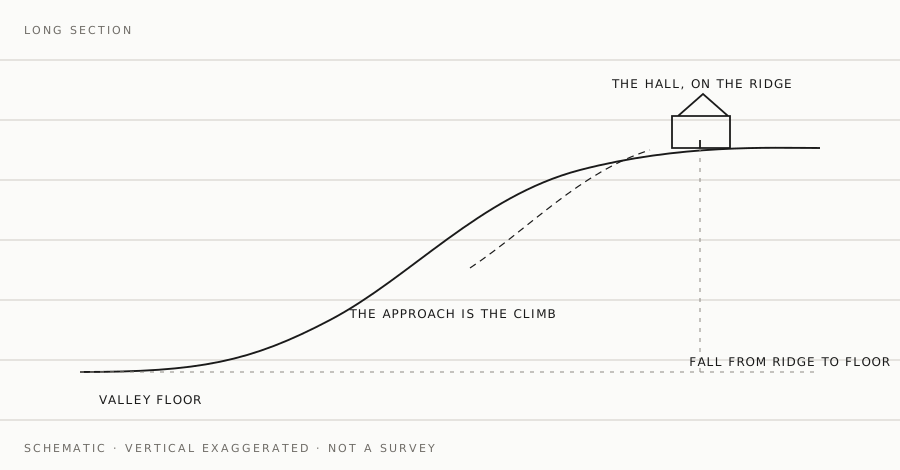
The siting is the point of the house. Hoghton sits on a ridge with a long view north over the Ribble valley towards Preston and the fells beyond, and south towards the Darwen valley. A fortified house on that ridge controls the road between two river valleys, which is why it is there and not in the more comfortable ground below.
On a clear day the view from the outer walls takes in most of the country between Preston and Blackburn. It is the single best reason to make the drive even if the house itself is closed, because the ridge road passes it.
That prospect also explains the avenue. A straight approach climbing to a gatehouse is an assertion, and it was meant to be read from a distance by people arriving on horseback as opposed to admired from a car park.
Questions about Hoghton Tower
What is Hoghton Tower?
A fortified manor house on a hill south east of Preston, above the Ribble valley — walled and gated, built around two courtyards behind a gatehouse, largely Tudor and later on an older site.
Is the sirloin story about Hoghton Tower true?
Partly. James I did visit Hoghton in 1617. The knighting of a loin of beef as 'Sir Loin' is a legend: the word sirloin comes from the Old French for the cut above the loin and predates the visit.
Who owns Hoghton Tower?
It has been held by the de Hoghton family for a very long time, and that continuity is why it survives as a single coherent house, not a subdivided one.
How do you get to Hoghton Tower from Preston?
By road — a short drive south east. It is not walkable from the city and there is no useful rail connection to the house itself.
What else is near Hoghton Tower?
Samlesbury Hall, the 14th-century timber-framed manor house in the Ribble valley. The two together make a full heritage day.