The Battle of Preston 1715: street fighting, surrender and the sites
Two battles carry this city's name. The second one ended a rising, and it was fought along streets that are still there.
Preston has two battles and they are seventy years apart. The first, in 1648, was Cromwell's: a field action north of the Ribble crossings that ended the Second Civil War in England. The second, in November 1715, was fought inside the town itself, and it is the one usually meant by the Battle of Preston — the engagement that ended the Jacobite rising of that year, and the one commonly described as the last battle fought on English soil.
What makes it worth a sheet on a city guide rather than a line in a history is that it happened in the streets. The Jacobite force did not meet an army in a field outside Preston; it barricaded the approaches into the town and fought from behind them, which means the action is locatable on a modern map in a way a field battle rarely is.
How a rising reached Lancashire at all
The 1715 rising was raised in Scotland for the exiled Stuart claimant, and one wing of it moved south through the north-west of England expecting English support to gather as it went. It did not gather in the numbers hoped for. By the time the column reached Preston in the second week of November it was a force of Scots and northern English gentry and their followers, some way from home and with government troops closing behind it.
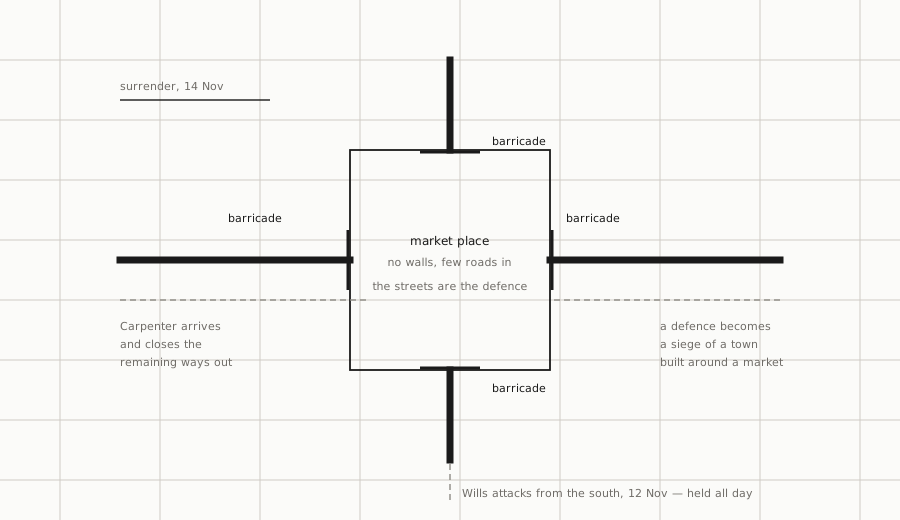
Preston was a natural place to stop. It held the crossings, it was the administrative town of the county, and it had the Georgian and pre-Georgian street pattern of a place built around a market rather than around defences — no walls to hold, and a small number of roads in.
The barricades, and the two days of fighting
The Jacobite commanders chose to defend the town rather than the river, and threw up barricades on the streets leading into the centre. Government forces under General Wills attacked on the 12th of November and were held at the barricades through that day; a second government force under General Carpenter arrived and closed the remaining ways out, which turned a defence into a siege of a town that had not been built to be besieged.
The surrender came on the 14th. The terms were harsh and the aftermath was a matter of trials and transportations rather than of further fighting, which is the reason the rising is dated to 1715 and to this town.
Where it is, in the city as it stands now
The fighting was on the approaches to the market place, so the ground is the modern centre: the streets around the market site and the runs leading into it. The pub name that comes up in accounts of the action — the Lamb and Packet — is on Friargate, and it is the reason a search for that name lands on this subject at all.
Nothing of the barricades survives, and no battlefield is walkable here in the sense that Marston Moor or Naseby are. What is walkable is the street pattern the fight used, which is covered by the blue plaque heritage walk through the Victorian and Georgian centre.
What was made of it in 2015 and 2016
The tercentenary was marked in the city in 2015, with a walking trail through the streets where the barricades stood and a further event for the 301st anniversary the year after. Neither ran again, so what is written below is the ground rather than a programme.
The wider heritage of the period is indexed on the heritage and sights sheet, and the two fortified houses east of the city — Hoghton Tower and Samlesbury Hall — are the buildings in the district that predate both battles.
Questions about The Battle of Preston 1715
Was the Battle of Preston the last battle on English soil?
It is usually described that way, and the qualification worth knowing is that the fighting at Clifton Moor in 1745 was a rearguard skirmish rather than a battle. On the ordinary meaning of the word, Preston in November 1715 is the last one.
There were two battles of Preston — which is which?
1648 was Cromwell's, fought as a field action around the river crossings at the end of the Second Civil War. 1715 was fought inside the town, from barricades on the streets into the centre, and ended that year's Jacobite rising with a surrender on the 14th of November.
Can you visit the battlefield?
There is no battlefield to visit. The action was street fighting on the approaches to the market place, so the site is the modern city centre; nothing of the barricades remains. The street pattern the fighting used is what a walk can still follow.
When exactly was it?
The government attack came on the 12th of November 1715 and the Jacobite surrender on the 14th.